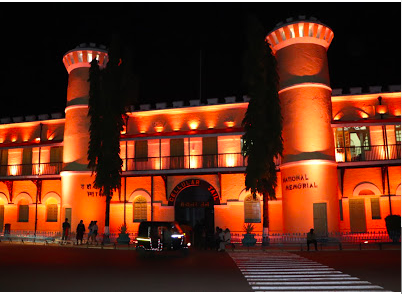
The Cellular Jail is now a National Memorial situated Port Blair, in the Andaman and Nicobar Islands (India). Cellular Jail is also know as kala pani because ocean water (pani) here is very deep and black (kala) in color.
Near to G.B. Pant Hospital, Atlanta Point,Port Blair
Cellular Jail is located around 2.5 km from Port Blair STS Bus terminus / Aberdeen Bazaar and is connected by road.
Visitors can take taxi / auto from Aberdeen Bazaar to reach here.
Tourist could also walk to Cellular Jail from aberdeen bazaar.
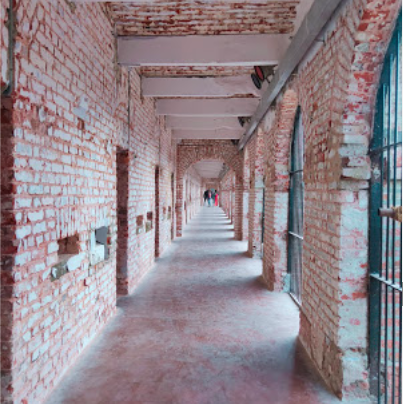
Kala pani ki saja was dreaded by even by worst kind of offenders.It was believed who gets Kala Pani ki saja,never returns back. The prison was known to imprison many notable Indian freedom fighters and political activists during the struggle for India's independence.
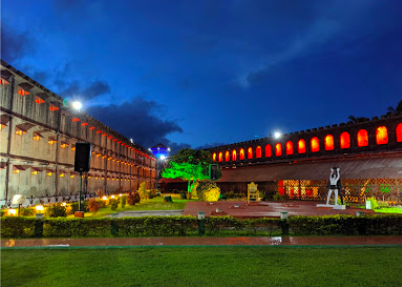
This is know as Bastile of India.It had witnessed "the saga of struggle for freedom of people kept in bondage by alien power". the saga of this histroic struggle is now brought alive in a moving son et lumière( Sound and Light Show) by the department of tourism runs this show based on history of this island and jail as if it is told by oldest "Peepal Tree",still standing in jail.
The Cellular jail stands as a mute Spectator to the inhuman sufferings of the patriots, freedom fighters who were imprisoned in the cells of this Jail. They even had to sacrifice their preciuos lives as victims of tyranny and brutalities of the British and Japanese Government. The colossal building imparts fear to the spectators and a feeling of great respect.
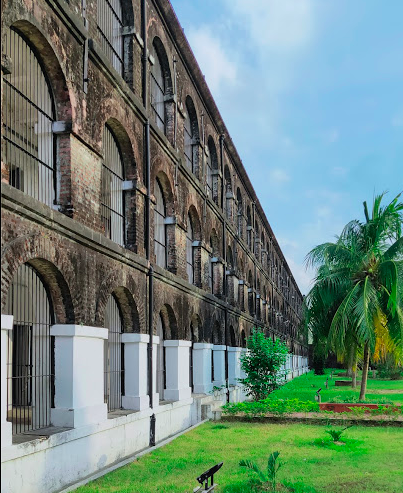
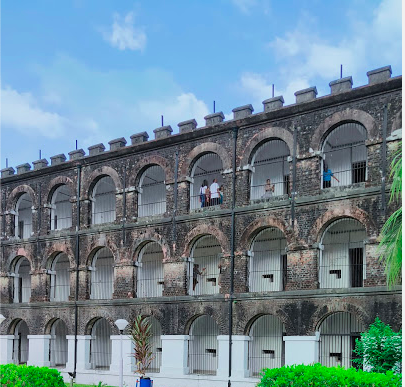
The construction of cellular jail was started in 1896 and completed in 1910 based on suggestion from on 1890's Lyall-Lethbridge commision. Every brick of the Cellular jail has got a heart rendering story of resistance, sufferings and sacrifices. The bricks used to build the building were brought from Burma, known today as Myanmar. The penal settlement established in Andaman by the British after the First War of Independence in 1857 was the beginning of the agonizing story of freedom fighters in the massive and awful jails at Viper Island followed by the Cellular Jail. The patriots who raised their voice against the British Raj were sent to this Jail, where many perished. The jail was constructed as a 3 storeyed edifice with 7 wings, Each wing stretching from Central tower like the arm of a star fish or the spokes of a wheel.
Each wing with a single row if cells closed by iron gate door,all facing the same direction and openning onto a verandah running full length of the wing and enclosed by griiled iron fencing. There was also an entrance block to the jail. It has 696 cell one for each person. The name Cellular Jail is derived from its unique feature as it has only cell and no dormitories and each cell measured 13.5 feet by 7 feet and had door with iron grating in the front. A 3 feet by 1 feet ventilator, nearly 10 feet high from the door was provided to each cell. the construction of the Jail was so made that the front portion of each wing was to face the back side of the other wing so that no prisoner could see one another during his confinement.
The room in the jail were in a row. The verandas about 4 feet wide ran all along the front surrounded by iron railings fixed into the arched pillars that support the roof of the verandas. All these corridors meet at the Central Tower, which alone has the gate entrance and exit. The rooms were shut by means of iron bolts and locks from outside and cannot be reached from within.
The three corridors consisted of upper corridor, middle corridor and the lower corridor. Wardens were appointed in each corridor in the night to keep watch. There used to be 21 warder simultaneously for watch duty Besides, sentries in the Central Tower also kept vigil throughout day and night even through chances of escaping from the jail was very remote.
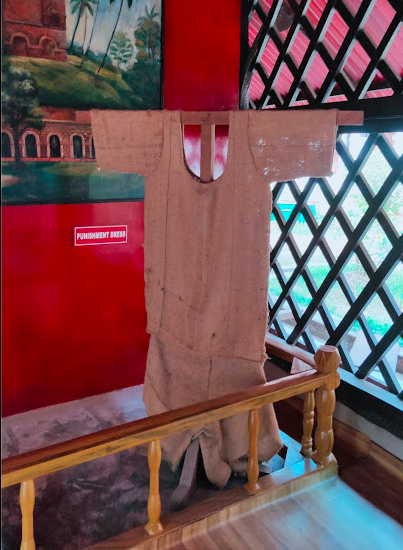
During twelve hours of the night, the warden insisted that the prisoner shall have no occasion to ease himself. The pot was so diminutive and that one could not discharge into it even once during the night. As for nature's call one had to go down on his knees to the Jamadar to let him out. The prisoner may not take the call seriously. He may be reluctant himself or he may fear the Officer. The prisoner had, therefore, to check it till the morning. If the prisoner realised and carried the matter to the Jamadar, the Jamadar would severely punish the convict for the call at such an odd hour.
He would or would not report to the doctor as he will not listen to him. The doctor's report on the ailment was never made or made only in one case out of a hundred. That report had to go to Mr. Barrie and Mr. Barrie would take action upon it at his own sweet will. Imagine the prisoner's condition during the night and during this process of ailment. Particularly when the call was not normal but an abnormal and sudden ailment. In the morning Mr. Barrie, would sit in judgement upon it, rebuke sternly the warder and the Jamadar for their lapses of duty.
The prisoner was also cross examined by Mr. Barrie and if the former said that he c ould not help the call of nature Mr. Barrie would beat him fiercely . And if the convict had the courage to say, I got it because I get it, the Jamadar would give a slap in the face and scold him for giving such an insolent answer. Usually the prisoner was let off only with stern word. But Mr. Barrie's normally put him immediately on the grinding mill.
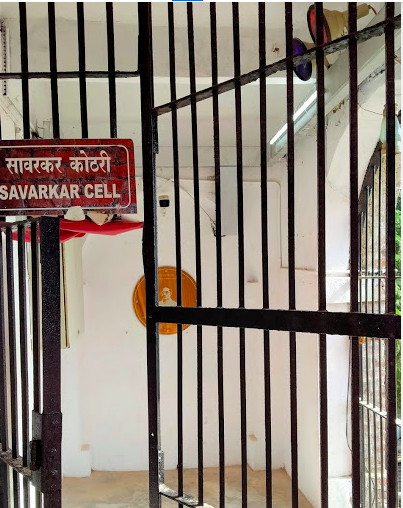
Some of the better known political prisoners incarcerated in the Cellular Jail were Barindra Kumar Ghosh, Upendra Nath Banerjee, Hem Chandra Das, Ullaskar Dutta, Indubushan Roy, Bibhuti Bushan Sarkar, Hrishikesh Kanjilal, Sudhin Kumar Sarkar, Abinash Chandra Bhattacharji & Birendra Chandra Sen. All these prisoners were sent to the Cellular Jail after 1910 on their conviction for participation in the Manictollah Conspiracy case. Vir Vinayak Damodar Savarkar was sent to Andamans on 4th July 1911 with sentence of two transportations for life.
When he came to the Cellular Jail his elder brother, Ganesh Savarkar was already there. But the Savarkar brothers came to know about this fact only after having been in Jail over a year.
Women life convicts had two classes to traverse- first three yaers of the punishment ward an dthe remaining yaers thereafter either outside the prison in marriage or domestic emeployment with consent of the authorities or else continuation of prision life in barracks with intar mural work and possiblity of rising to petty officail positions.A woman life convicts was free to leave after 15 years,but married one has to wait till her husband's term was complete.Term convicts of the both person stayed in prision on usual conditions for their whole term and were released at once on the expiry of their conviction periods.
| Version | 1st Show | 2nd Show | 3rd Show | 4th Show |
|---|---|---|---|---|
| Hindi | 5:30 pm to 6:30 pm (Every day) | 6:45 pm to 7:45 pm (Every day) | 8 pm to 9 pm (Tue, Thur, Sat and Sun only) | 9:15 pm to 10:15 pm |
| English | No Show | No Show | 8:00 pm to 9:00 pm (Mon, Wed and Fri only) | 2:30 |
| Version | 1st Show | 2nd Show |
|---|---|---|
| Hindi | 5:45 pm to 6:35 pm (Every day except wednesday) | 6:50 pm to 7:00 pm (Every day except wednesday) |
According to Andaman and Nicobar Gazetteer 1908, the life convicts were received into the Jail for six months, where the discipline was of severest, but the work was not hard. They were then transferred to the associated Jail for 18 months, where the work was hard but discipline less irksome. For the next three year the life convicts live in barracks, up at night and go out to labour under supervision. For that labour he received the reward, but his capabilities were studied.
During the next five year he remained a laboring convict but was eligible for the petty posts of supervision and the easier forms of labour, he also got a very small allowance for little luxuries, or to save in the special Saving Bank. After completing 10 year in transportation he received a ticket to leave(self supporter). In that condition he earned his own living in a village he could farm, keep cattle, and marry or send for his family.
But he was not free, had no civil right, and could not leave the settlement or be idle. After 20 to 25 years spent in the settlement with approved conduct he ight be absolutely released. While a self-supporter, he was at first assisted with house, food, and tool, and paid no taxes or cesses, but after three to four year, according to certain conditions, he received no assistance and was charged with every public payment, which could be demanded of him, he be a free man.
Prisoners below twenty years of age could not be assigned arduous manual labour; literates were employed in the press and the work was assigned according to the physical fitness of the prisoners. Political prisoners were treated differently. The tasks for which convicts confined in the Cellular Jail could be employed were:
- 1. Cane and bamboo work
- 2. Coconut and mustard oil mills
- 3. Husking and opening coconuts
- 4. Drying copra
- 5. Making hooka shells
- 6. Coir pounding
- 7. Sisal pounding
- 8. Rope making
- 10. Carpet making
- 11. Weaving towels
- 12. Coir and sisal hemp mat making
- 13. Cleaning mustard seeds
- 14. Blanket mulling
- 15. Gardening
- 16. Hill cutting and swamp filling in (when necessary)
- 17. Miscellaneous such as conservancy, cleaning drains etc. around the jail
- 18. Hospital ward coolies, sweeping etc.
- 19. Clerical work in the jail office.
The second world war started in 1939 and Japan joined in the fray in december 1941.Japan invaded urma now Mayanmar on 11 december 1941 and Bristish evacuated Rangoon on 7th March 1942. The evacuation decided the fate of Andaman Islands also.The first Japanses air raid on port blair took place on februaury 16,1942 and the hostilities by air and sea intensified thereafter. he british move back to Calcutta(now kolkata),evacuating the island by 13th March,1942. The ajpanese moved in on 23 rd March,1942,quite unopposed ,snaking their way in a three column pincer foramtion to the center of town to surround the tight knot of the officers and policemen gathered in grim face to surrender.The only figures of authority left on the island were Chief commissioner Sir C.E. Waterfall and his assistant, Major A J Bird, who opted to saty behind.
With them were 6000 convicts,some in cellular jail and 12000 of the local born population.Not a shot is fired and telegraph office was blown off by telegraphist.The japanese begin resonably enough and their welcome ,if apprehensive was not hostile ,with the people willing to extend cooperation and praticipate in peace and collaborate. The japanese begin arresting Waterfall and Bird,realesaing the convicts of the Cellular Jail ,assuring the populace taht it had nothing to fear if it co-operated. But the japanese left no one in doubt that they were a conquering army. As on eof the first act to terrorise the populace,they publicly beheaded Major Bird ,on the charge of attempting wireless contact with the enemy,with such a barbarity,breatinga nd kicking him and breaking his ankles and shoulders with their bare hand before cutting of the head with sword.Shortly afterwards,reprisals began against indians.
When a british submarine appaered off ross island and attacked installations in Port blair,they rounded up sixty odd persons for intrrogation and threw them in Cellular Jail.In october 1943,the arrested 600 persons including women ,who all are active members of Indian Independence league and Local Peace Committe and brutally tortured in suscpect of passing sensitive information to the enemy.
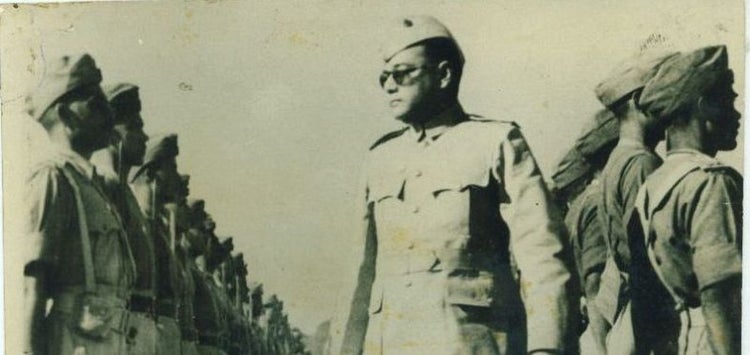
In octobar 1943,The provisional Indian goverment was formed in Singapore by the Japanese under the leadership of Subhash Chandra Bose and the annoucemnt was made that Andaman and Nicobar Islands would be handed over to it. Subhash Chandra Bose arrived at port blair on 29th of December,1943 at about 11:30 am in Japanese Air Force Craft.He was accompanied by few of his staff officer and was recevied at the airport by Ishikawa,the admiral in chrage of the islands occupation forces and other senior Japanese civil and military officials.
There was guard of honour.Then he was taken away to Ross Island (Now Netaji Subhash Chandra Bose Deep) for teh duration of two days stay.He didnot get an oppurtunity to meet local people.Though he visited Cellular Jail where executives of Indian Indpendence League were being held and tortured.He has also made public address,but the true state of affairs in the town were kept secret by japanese in cunning way. December 30th, 1943, Netaji Subhash Chandra Bose unfurled the Azad Hind National Flag for the first time at the Gymkhana Ground ( Netaji Stadium) in Port Blair.
He declared the Andamna and Nicobar Islands, the first Indian Territory librated from the British rule. A month after he has left andaman, Provisional Goverment comprsing Lt. Colonel Loganathan and four others arrived on 22nd February,1944.Only education,civil sipplies and agriculture were placed uder its control and the overall charge continued with Japanese Army. A week after Provisional Goverment arrived,44 suspects were taken by Japanese from Cellular jail to Homfraygung and shot dead and buried in mass grave.
In Port Blair,mass execution to peune the size of population continued well after the official surrender of japanese.on 13th August 1945,around 300 people ,rouded up a few days earlier from Garacharma,were taken to Tarmugli Island and shot dead by firing squad. Acouple of month before this ghastily incident ,about 6000 prisions had benn herded into three boats, driven a kilometer off the havelock island and made to walk off the boat at gunpoint to thier death into rough sea.Japanese were so entrenched and prepared for war that the news of Japanese surrender had ben dismissed as war propganda.
On 6th Aug, 1945, Atom Bomb was dropped on Hiroshima.On 14th August, 1945 Japan surrendered unconditionally.It took a personal visit of Emperor's brother to Port Blair to convince the commander ,in October 1945,two month after official surrender,that the war is indeed over. Brigadier AJ Salomon landed in Port blair in Ocober 1945 to take formal surrender.
With the end of Japanese occupation of Andaman,the Cellular Jail also came to teh end of its infous life as a jail.on eof the first thing the goverment took upon reoccupation was to abolish the penal colony,and ,with the magnanimity no doubt caused by the horrors borne by the Islands,to grant remission of their sentences of about 6000 convicts of the islands.Two wings of cellular jail has been demolished by the Japanese for the material with which to build their fortification and a great deal of remaing of Cellular Jail has been damaged in the bombing.
A third wing of cellular jail is now dismantled to make way to GB Panth Hospital.The Millitary establishment, set up to deal with prisoners of the war,around 20,000 and war crimes,amde ways for civil adminstration in Feb,1946,with NK Patterson taking over as Chief Commissioner. Patterson handed over to Inman Ul Majid in Feb,1947.He has become First Andaman Chief Commisoner of Independent India.
Savarkar in his celebrated book 'The story of my transportation for life' refers to a certain utterances of Barrie the Jailor to the prisoners "Listen, you prisoners, in the universe there is one God, and he lives in the heavan above but in there are two one, the God of Heavan and another, the God of Each! Indeed the God of earth in that is myself.
The God of Heavan will reward you when you go above. But this God will reward you here and now. So you, prisoners behave well. You may complain to any superior against me but my work shall prevail; hold my own, Mind you well". Savarkar while describing the Jail conditions says " who can describe the suffering the agonies of mind & body ? I may give you an instance, however, to point the moral of all the hardship of prison life in the Cellular Jail of the Andamans grueling work , scanty food and clothing, occasional thrashing and other none was so annoying and disgusting as its provision for urinals and lavatories.
The prisoners had to control the demands of nature, for hours together, for want of these arrangements in the cell itself. Morning, noon and evening these were the only hours when prisoners were let off this convenience at any other moment than the stipulated hours. The prisoners were locked in their cell at four or five o'clock in the evening and the lock was opened only after six in the next morning. A sort of clay-pot was given to them to use for urination during the night.
Barindra Kumar Ghosh, younger brother of Maharshi Arabinda Ghosh, while describing about the inadequate and insufficient quantity of food says that "the next morning we came out and washed our face and then had for the first the darshan of ganji,otherwise called 'kanji'. It means boiled rice churned in water one may say, a sort of rice porridge. We were given each a 'dabbu' full of this dainty. Dabbu is a kind of primitive spoon, made of a broken half coconut shell with a canehandle fixed to it.
The Ganji was saltless Therefore, tasteless. Each prisoner was allowed only one pinch of salt per day and,this was requied for the dal and the vegetable, the Ganji had necessarily to go without salt. Had to swallow the thing with utmost preservance, in spite of its tastelessness.

Bangalore
Andaman Beacon
Gear Road, Doddakannelli
Bangalore, Pin 560103
Andaman
Andaman Beacon
Link Road, Goalghar
Port Blair Andaman -744101